Grant Writing for Writers and Artists
This is the first in a series of posts about grant writing for writers and artists.
In a conversation with a friend, a theatre producer, he said that he knew lots of artists with great ideas, but they had trouble getting funding.
Funding applications can at times feel impenetrable. You have an incredible idea and an unsuccessful application can knock you for six.
The main point I would make is this. The idea itself is just one part of it.
Funding applications have their own back-story. This post will decode this for you and help you write proposals with a higher chance of success.
Jump to a Section
- How to Analyse a Grant Form
- The Grant-Writing Workflow
- Ethical AI use in Grant Writing
- The DNA of an Application Form
- The Takeaway
How to Analyse a Grant Form
So it's not just about your idea.
Funding bodies have their own list of things they need to fulfil for the Government. These are things you should make yourself aware of - policies, frameworks…and how they interact.
Everyone has a boss. And that boss, is Government legislation. And it's easier to get a handle on that you think.
The form you have to fill to get funding for your project sits in a frame of policies created at different levels - by a public body and by the Government.
You don't just have to create a fantastic piece of work. You need to consider how it fulfils key aims that the Funding Body and the Government are striving for.
You have to consider how your idea serves the aims of the funding body. And the funding body answers to the Government. It's turtles all the way down.
The Grant-Writing Workflow
The following tools will help build an accessible frame-of-reference that can grow over time. A digital grant-writing Second Brain which will help with the dreaded white page.
These three apps work in conjunction. Zotero for collecting and organising your research. Obsidian, an amazing knowledge management app. And Claude Cowork, for interrogating your notes and finding connections across your research.
You can find an introduction to Obsidian for writers and grant-writing with Claude Cowork on the blog. You can use them individually or as teams.
Ethical AI use in Grant Writing
A note on AI use in the context of grant-writing. It's an amazing tool for research, handling sources and testing arguments. But I would strongly advise not using it to do the writing itself.
First of all, the writing is the thinking. You need to write to make the connections between ideas yourself. Out-sourcing that to a black box doesn't do you any favours.
Also, if you're using AI to do your actual writing, anyone can do that. Most people are good spotting it, and there are always apps like Turnitin. Or you can just ask an AI their view on a piece of text. Ask yourself, if you were in charge of the money, and you got boilerplate answers back, how would you feel?
I've written an article about this - The Uniqueness of Your Writing Voice.
I like using AI to help with time-consuming tasks. Finding sections in long reports. Creating proper formatted citations. Creating FAQ schema and other small bits of code. And as someone to tell me where the weaknesses are,
The DNA of an Application Form
Let's take Creative Scotland as an example. Creative Scotland is a Public Body concerned with promoting the Arts in Scotland. It was created in an Act of the Scottish Parliament in 2010 - The Public Services Reform (Scotland) Act 2010.
Let's look at the DNA of a CS Open Fund application. What sources is it pulling from? What is it trying to achieve, not for you, but for the funding body? What's the sub-text and what's on the nose?
In the Public Services Reform Act, the Scottish Government created Creative Scotland and told them some of what was expected of them. These are Statutory Duties, they are written into law. They are broad in wording, in general, allowing the Government of the day some lee-way in interpretation.
The Government also draw up what they call the Creative Scotland Framework Document - where they tell Creative Scotland what they want, in a very on-the nose way.
1. This framework document has been drawn up by the Scottish Government (SG) in consultation with Creative Scotland. It sets out the broad framework within which Creative Scotland will operate and defines key roles and responsibilities which underpin the relationship between Creative Scotland and the SG...
4. Creative Scotland is to contribute to the achievement of the SG’s primary purpose of increasing sustainable economic growth by aligning its aims and objectives with the Programme for Government, Scotland’s National Strategy for Economic Transformation and National Performance Framework...
This obviously feeds through into Creative Scotland's own strategy and policies. Because if they don't do this, politicians will get mad with them.
Let's look at an example of how an idea travels through all of this. Then you will see an example of a direct line between the Scottish Government's National Performance Framework (which is being re-done at the moment, this is the archived version) and Creative Scotland's strategy. The one in the graphic below at 7 o'clock clock concerns 'Fair Work'. Let's track that one.
We have thriving and innovative businesses, with quality jobs and fair work for everyone.
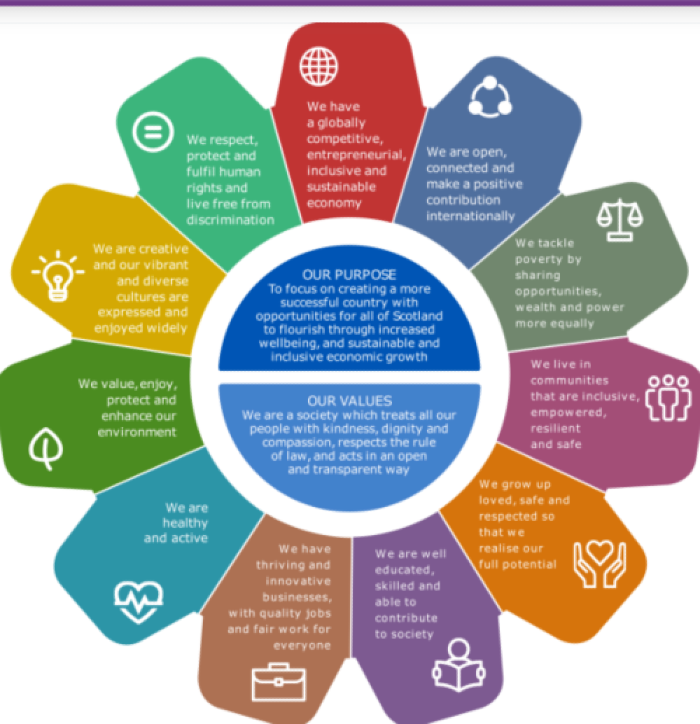
Let's see how that manifests in the Creative Scotland Strategic Framework. You can see the third point is about Fair Work.
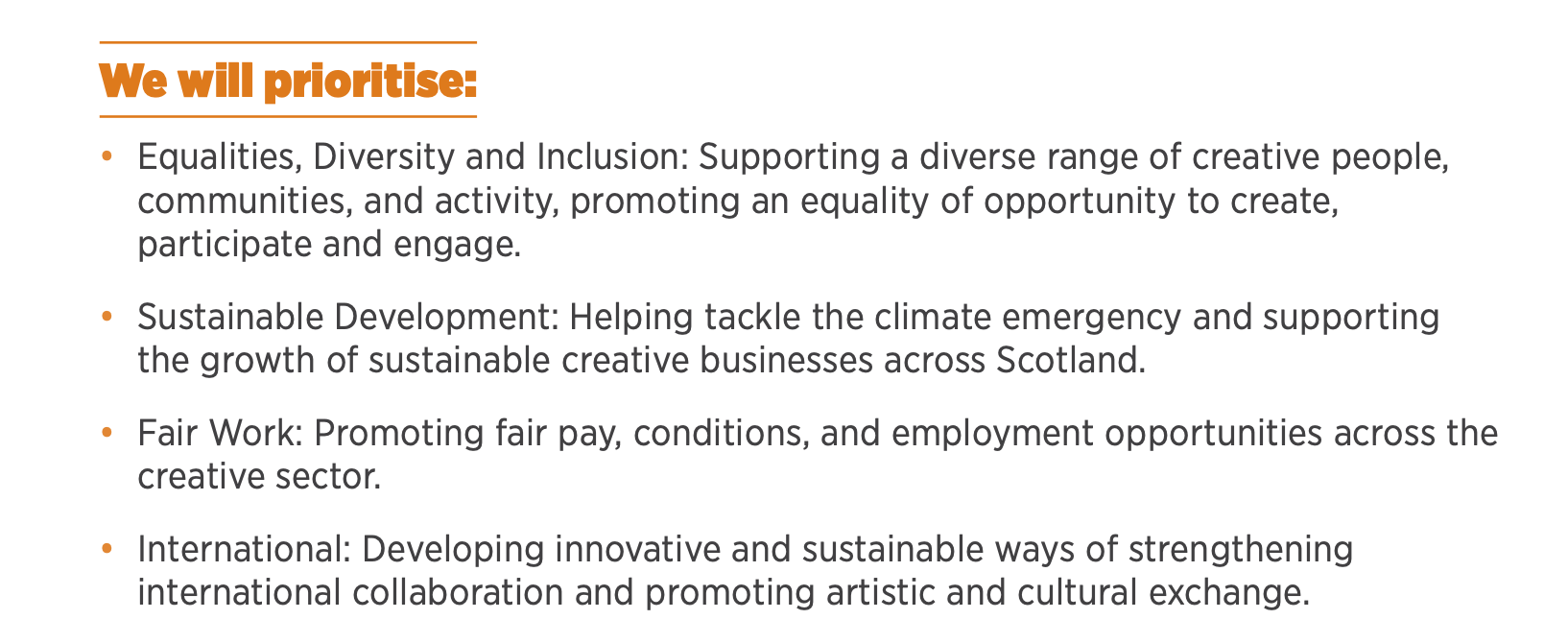
So the Scottish Government policy on Fair Work feeds into the strategy of Public Bodies.
Eventually, it feeds into the form you have in front of you.
That is why you are looking at a section of the form where you have to consider things like paying the Living Wage or above, for your project. And/or whether workers in your company have an effective voice.
Here it is in their guidance for the CS Open Fund.
2. Fair Work
Projects should demonstrate Fair Work in the development or implementation of their activity, particularly in the context of applying industry recommended pay rates. Panels may prioritise projects that:
Support a significant change in an individual’s development as a creative practitioner, enabling them to access opportunities that would otherwise not be available to them.
Respond to a sector need, for example a gap in skills or expertise, or benefit other individuals in that sector, for example through peer sharing or engagement with sector networks.
If you can't demonstrate you have thought of this, or are not supporting this, it weakens your application.
Like I said, it's turtles all the way down.
The Takeaway
When you look at the overall complex system, I think it's fascinating. Writers and artists have the perfect skills to navigate this - understanding narrative, sub-text and motivation.
I hope this shows a route towards supporting your creative practice by creating funding applications with a higher chance of success.
You might also like this post - An Experienced Assessor's Guide to Writing Better Grant Applications.
Other Grant-Writing Resources
Going forward we'll expand on this small example. We'll look at the key areas we need to be thinking about to improve our grant writing.
I've written posts on using Microsoft Copilot for grant writing. and using Claude Cowork for grant writing.
We'll look at fantastic frameworks like the UK Government's Green Book and the Five Case Model for building a business case (which is imbedded in the Green Book). These support shaping our projects.
We'll develop our digital chops, building our grant-writing Second Brain - exploring Obsidian for grant writers and an Obsidian Zotero workflow.
There's also the Arts Green Book, a look at Net-Zero and the work of Culture for Climate Scotland and much more. Now we have the beginnings of a frame of reference, it's much easier to explore these things.
Thanks for reading.