Writing through Grief
This post talks about the subjects of bereavement, grief and mourning. If these things have touched your life, please take care when reading.
Grief is a madness, a missing space in the world which will never be filled, uncontrollable, sometimes hidden until the time of its choosing, for years.
In the aftermath of a bereavement, you return to the world in some way, but not fully. You wear a version of yourself so your grief doesn't flood rooms, conversations, memories, your work. You sit at your desk, objects or photographs that were before quiet, memories you collected, now seem to have their own monologues which they insist you listen to.
You swim in the sea for some respite, it comes and goes and sometimes you feel almost normal, but you don't trust it. Drinking carries a terrible cost. Walks, books, music ,too many reminders. Grief is happy to take many forms, it finds its way like water, Sometimes a stone you carry sometimes a wave.
And then you have to work. Some find work helps. But the exhaustion. Time helps, people say. Or is it that you just grow around your grief more, so gradually, it doesn't take up all the space.

It's a difficult subject to talk about.
Last week I spent the day with other coaches on a workshop about the subject of death and grief. Things to think of when coaching someone going through loss, or when you yourself are. It was run by Relational Dynamics 1st, based in Lancaster, where I trained as a coach. It was a privilege to be part of.
Here are some of the things which struck me.
It was good to clarify the terms related to death. A bereavement is the loss, the death. Grieving is "the psychological components of loss". Mourning is the expression of grief, often with a cultural component. My experience of bereavement is most often in a Gaelic speaking context, I hadn't thought of how that affected my conceptual view of it.
It's good to give names to things. "Anticipatory grief" is a concept I learnt. It is grieving that begins before the actual loss. For example, in the context of terminal illness or decline over time.
There are different models of grief and one of the best things I realised was, I could ignore them if I wanted to.
For example, Elisabeth Kübler-Ross' 'Five Stages of Grief' (1969) - Denial, anger, bargaining, depression, acceptance. So...great, I now have six months of depression to look forward to? That isn't helpful.
The grieving process isn't linear (neither is the model to be treated as linear, to be fair). Grief is always happy to wait. I saw a photo of my grandfather the other day, taken during the war. I burst into tears. All these years and still there it is.
There was one model I liked, the Tonks Model (Lois Tonkin, 1996). Tonkin was a grief counsellor. She developed this after listening to a women talking about her grief journey. The grief was still there, but her life had grown round it, making it less all-consuming.
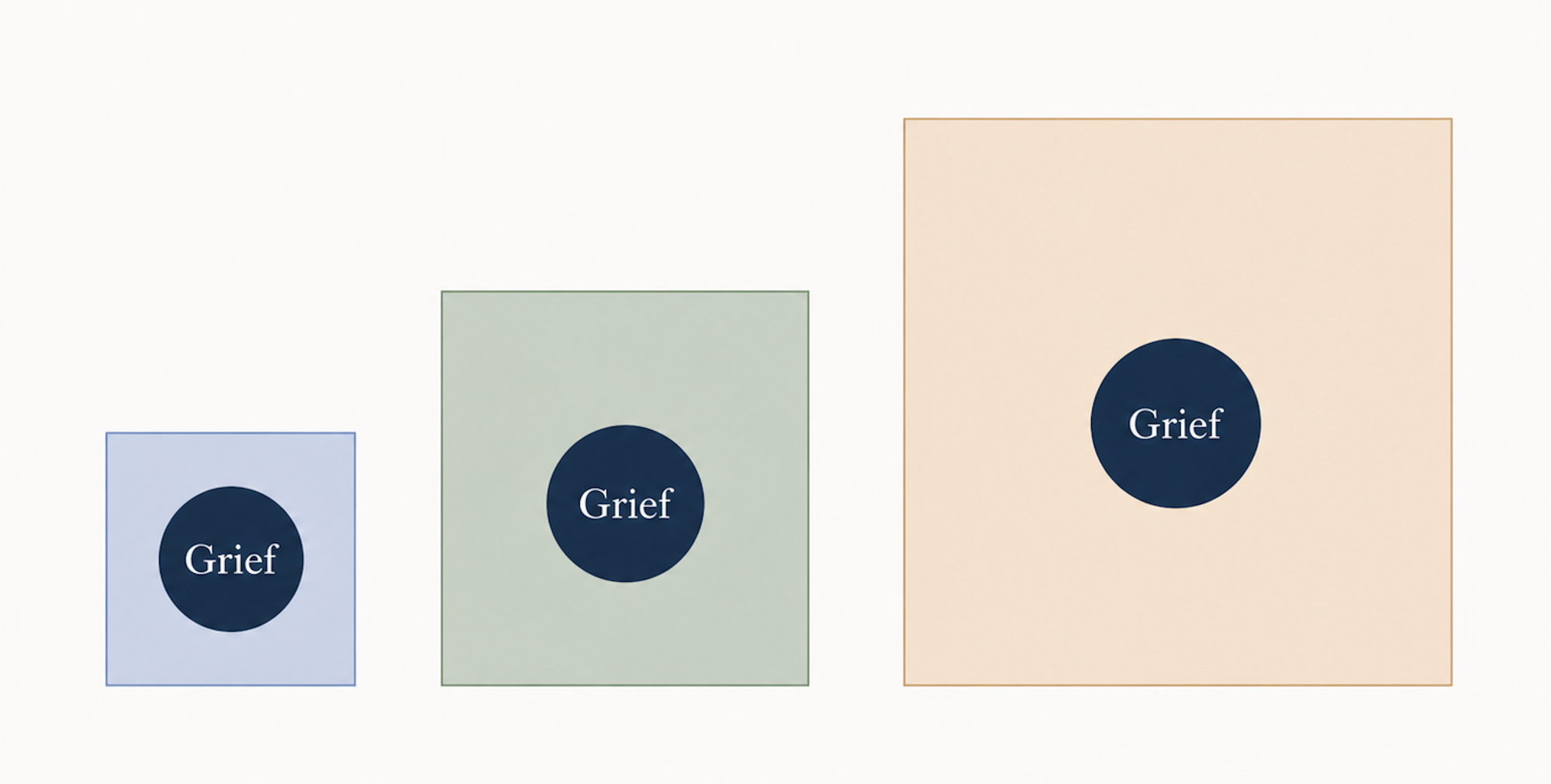
Silverman & Klas's 'Continuing Bonds' is also interesting. It challenges the notion of ‘getting over it’. It makes normal an ongoing engagement with the relationship, if it's something you want. Rituals can be a component of this, for example, celebrating a person's birthday.
Some people use a memory box technique. Objects of meaning. So when grief rises, you can tell yourself - I can set this grief aside just now, as I've made a time to be with this properly later.
As a writer, this can be a form of memory box. Whatever form of writing it takes. I like to write about the subjects my uncle Finlay was interested in, for example, although it's difficult. But writing is precious when you go back to it.
In short, how you react to grief, however that may be, and when you do, is a perfectly normal and valid experience.
Is there a therapeutic aspect connected to writing about emotional experiences? This is outwith my circle of competence, but there is academic writing about it which I will engage with such as J.W Pennebaker's work on the subject. One of his papers is “Writing About Emotional Experiences as a Therapeutic Process”.
This is an interesting article in the Marginalian. It quotes neuroscientist Mary-Frances O’Connor who studied the neurophysiology of grief.
The brain devotes lots of effort to mapping where our loved ones are while they are alive, so that we can find them when we need them. And the brain often prefers habits and predictions over new information. But it struggles to learn new information that cannot be ignored, like the absence of our loved one.
As far as coaching when grieving goes, a good bit of learning was to be mindful of how it affects you as a coach and the coaching process. Are you in a resourceful state for coaching. Are you sharing your own experience more, and if so, take care as to who this is serving. I won't say more as the best way to engage with it is in a proper session with skilled RD1st coaches.
We never know what other people are going through. We might go to the supermarket and have no idea the person we're passing is carrying the weight of grief. Maybe, like a friend of mine who lost their pet, they can't bear to walk up the petfood aisle. We never know.
Thanks for reading and take care.
Here is a short film I made which touches on these subjects. It is called "The Beach - An Tràigh".