Understanding the German approach to making theatre
A guide to director-led theatre practice in Germany, contrasting it with the writer-led traditions commonly found in the UK.
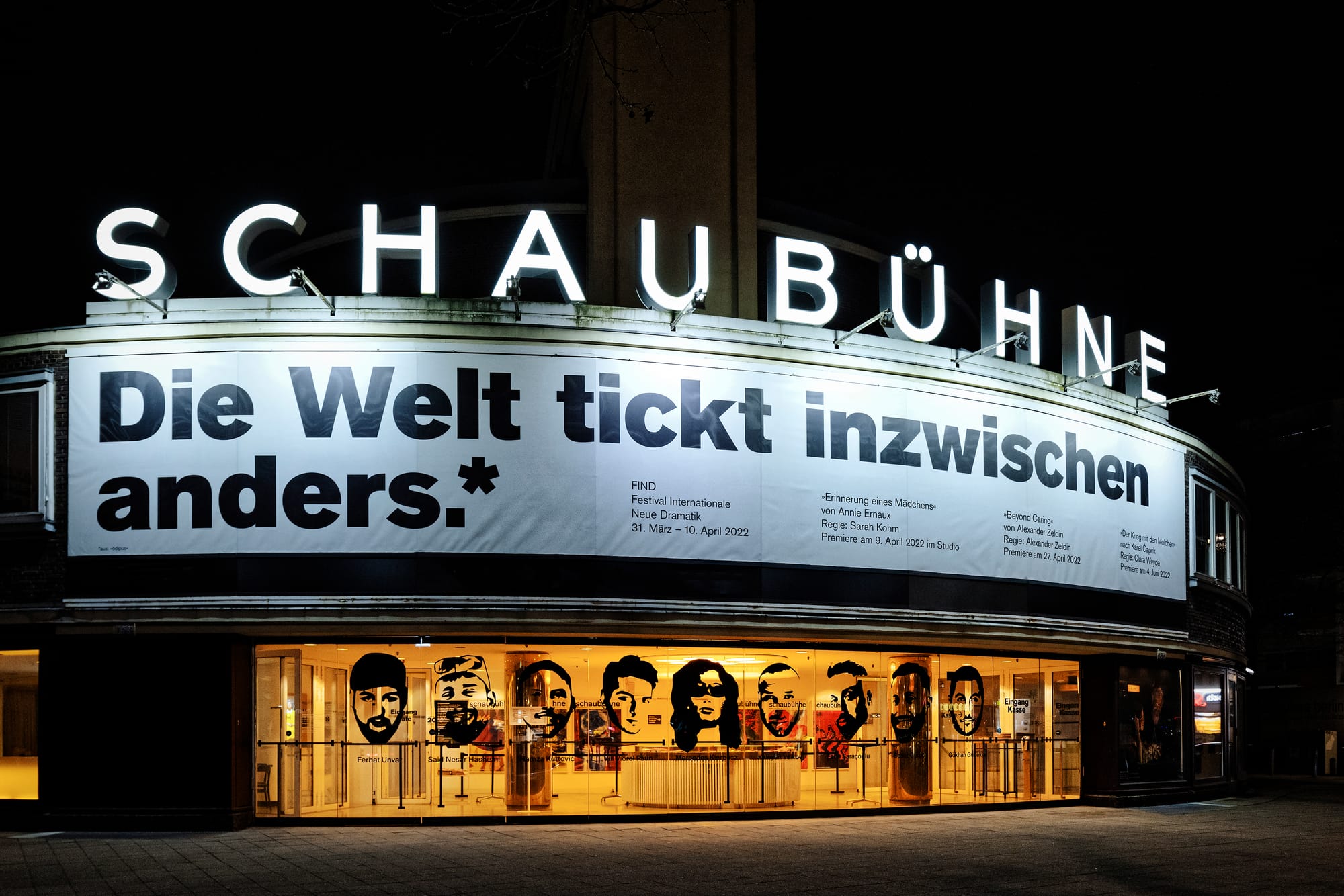
This post explores the director-led model of theatre-making and how German directors, dramaturgs, and writers collaborate to redefine a text. Using insights from Kai Fischer and the Schaubühne Berlin, we examine the creative tension between text-led and director-led approaches. We explore examples of groundbreaking German theatre like Müller's Die Hamletmachine and Thomas Ostermeier’s Shakespearean productions. Understanding these German methodologies helps expand what we think is theatrically possible. This overview serves as an entry point into a complex, evolving landscape.
Links to sections:
- How do German theatre directors treat the text?
- The writer led approach vs the director led approach
- How does the German dramaturg fit into the process?
- Three examples of writing for German director-led theatre
- The Ugly One by Marius Von Mayenburg
- Die Hamletmachine by Heiner Müller
- Thomas Ostermeier's production of Hamlet
How do German theatre directors treat the text?
Very broadly, in the UK, directors are more likely than their counterparts in Germany to follow how the play is laid out in the script.
In Germany, if that were to happen, Kai Fischer says the audience would ask - "well, what's different? I could have just bought the playscript." So the director is expected to bring a certain vision to the script, another layer, a re-imagining.
There is a paper on the site by David Lan, who ran the Young Vic from 2000-2018. He changed how the Young Vic approached theatre-making.
In an interview in the Guardian he said : "One of my guiding principles is to make this a director's theatre." What did that look like? Here is Lan talking about it in the piece he wrote called A Leap in the Dark.
Until you experience Berlin theatre you can't imagine it – a production of Molière where it snows non-stop for 6 hours, or another which involves the lead actor plastering himself with a whole picnic's worth of food while wearing a scooped-out watermelon skin as a helmet.
I offer just two typical examples. And when you do experience this theatre, you become a little bit more free as an artist, and consequently a little bit more capable of communicating through art the complexity of your own special and individual experience of living in the world.
He invited nine young directors to Berlin to shock them, to blow their minds. To "thoroughly unsettle them and shake them up with the discovery of what extraordinary things it is possible to do on a stage".
The writer led approach vs the director led approach
Fischer says that no one approach is better than the other. The UK tends to produce good text - the German approach offers strong stage interpretion and that could be why a lot of plays are taken from London and put on in Germany, but not so many in the other direction. It's easier for text to travel.
The German way of making theatre can lead to brilliant, exciting work, but its emphasis on the director means that the emphasis is not as much on the text as it would be in the UK.
I ended up working on a director led production once and I wish I had had a better grounding in what was going on. the German directors considered the text to be one of the elements of the work they putting together.
They took on the role more of the originating rather than the interpreting artist. And so for someone from a UK writer-led process, it took some adjusting to. That's an understatement. They were however very respectful of the text.
There will always be some positive creative tension between these two approaches, I think.
How does the German dramaturg fit into the process?
The German dramaturg then, fits into this space of re-imagination, making sure that the story is still clearly told and works dramatically.
It of course comes down the personal relationship between a director and dramaturg, but the dramaturg would generally work very closely with the director in the following way.
The director would talk to the actors, so that they don't feel they are being told different things from different sources. Of course this can be different depending on who is in the room, but it makes sense that there's some kind of decision hierarchy and paths of communication that people follow in the rehearsal space.
The dramaturg also acts as in-house critic for the work, and is a great sounding board for the writer. Again, I have worked with dramaturgs who originate ideas for the play, as well as those who focus entirely on helping the writer, without given strong direction on where things should be going.
Three examples of writing for German director-led theatre
The Ugly One by Marius Von Mayenburg
Reading 'The Ugly One' by German Playwright and Dramaturg Marius Von Mayenburg (which I thoroughly enjoyed), I was interested by the almost absolute lack of stage directions, no information on setting, no info on when characters come on stage etc.
Fischer says that there is a tendency in German theatre to leave this space for the director and their interpretation of the text. In fact, some directors consider the text as just one element that they can use amongst set design, sound design, movement etc.
Die Hamletmachine
Advisory - This play contains intense and potentially distressing material (although I don't mention it here).
Die Hamletmachine was written by Heiner Mūller in 1977 and is a post-modern, experimental theatre text. In post-modernism, the idea of a central grand narrative is rejected. There is fragmentation rather than plot. The character is unstable. The play is conscious of its own theatricality.
It is ostensibly about an East German academic reflecting on power, violence, and culture but it can be interpreted in multiple ways.
In a New York Times review of Hamletmachine by Mel Gussow, he says "
The plays by Heiner Muller are as dense as they are brief - shell fragments fired into our collective psyche. This East German playwright subscribes to the theory that ''theater is a laboratory for the social imagination,'' and, in ''Hamletmachine,'' he deconstructs Shakespeare in order to contemplate and comprehend the disintegration of civilization.
Hamlet's madness becomes Muller's obsession, and he sees in it, in particular, a reflection of Germany today.
The play collapses in on itself at times, with the actor stepping out of the role and commenting on it. The text also does this. The character starts off as Hamlet. By the second line, that has been dismissed.
Ich war Hamlet. Ich stand an der Küste und redete mit der
Brandung BLABLA, im Rücken die Ruinen von Europa.
I was Hamlet. I stood on the coast and spoke with the
surf BLAHBLAH behind me the ruins of Europe.
He disrupts his father (King Hamlet)'s funeral procession in an extremely shocking way. After that, well... welcome to the thunder dome.
Gossow's review also says :
In its published version, the Muller play barely fills six pages, representing, in the author's words, ''the shrunken head of the Hamlet tragedy.'' Merging Muller and Shakespeare, the play uses some stage directions as dialogue and creates a collage of horrific events. The Wilson variation runs more than two hours without intermission, which means that at least three-quarters of the work is Wilson's invention...
Thomas Ostermeier's production of Hamlet
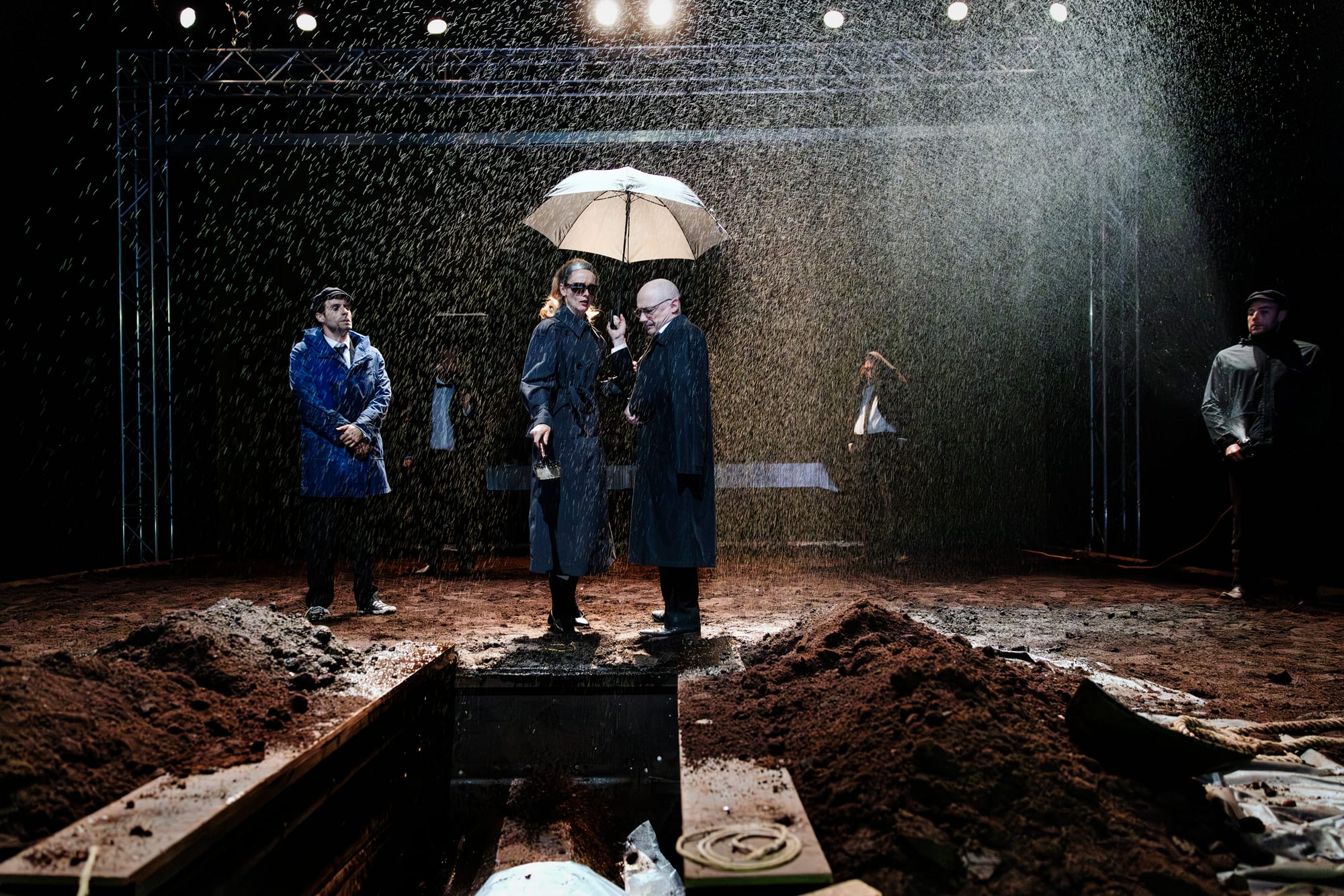
I wrote a piece about a three day workshop I did with Thomas Ostermeier.
I saw his version of Richard the Third, which was amazing. His staging of Hamlet has been touring the world for years.
The stage is a great lake of mud and earth. Wine and food fly around the theatre. Hamlet writhes around in the mud. He eats the mud.
Ostermeier said that he creates theatre to explore things which are taboo, behaviours you couldn't access elsewhere, a place where we can examine the darkness.
Here is the trailer.
So Pinter stopping rehearsal to tell an actor they missed a full stop, it ain't.
Schaubühne Theatre Interviews & Texts section on their website (some in English)
Mel Gussow's review of Hamletmachine is in the New York Times archive and so should be accessible without a paywall.
Learn more about Kai Ficher’s work here : http://www.kaifischer.co.uk